One of the constant threads running through this blog from the very beginning has been provincial politics. To this end, I am starting a weekly round up of stories from Queens Park and beyond.
-
This past week saw the race for PC Party president kick in to high gear. Three individuals officially announced their intentions to run Richard Ciano, Kevin Gaudetand John Snobelen. First Richard Ciano made a significant social media splash by announcing his candidacy Live via Web conference. Ciano, outlined some of his main priorities that he would pursue as president.You can watch the full video hereAs well Kevin Gaudet, former candidate and past president of the Canadian Taxpayer Federation announced his intentions to seek the top job . Although not as specific he outlined his priorities in a brief profile.Finally, former mpp John Snobelen talked toToronto Sun columnist Christina Blizzard about his bid to become party president.They’re all strong candidates who have different areas of expertise it will be interesting to see who comes out on top in February.
-
Here is my article from The Prince Arthur Herald
This week, a cloud will hang over the CBC’s official celebration of what was supposed to be a landmark occasion, the 75th anniversary of the crown corporation’s founding. Instead, jokes surrounding journalistic integrity, as well as the relevance of public broadcasting in Canada, will represent the watchword among the chattering classes in Canada. From a princess warrior gone awry, to access to information hearings, last week was certainly interesting for the CBC, as two seemingly disconnected events helped to highlight the hubris inside the Canadian Broadcasting Corporation.
Originally, the raison d’être of the CBC was to provide a Canadian voice in broadcasting from coast to coast. In fact, one of the call signs for the CBC in the 1970s was: “When you watch, watch the best”. This statement brings us to the present, and the events that transpired over the course of the past week, as the CBC engaged in practices that wouldn’t muster a passing grade in a first-year journalism ethics course.
First, the comedy sketch show This Hour Has 22 Minutes attempted an ambush-style interview early Monday morning at the home of Toronto mayor Rob Ford. Shortly after, the comedy stunt backfired on the broadcaster; in response, they spread misinformation about Ford’s statements to the 911 operator during the event. “Watch the best”, I don’t think so.
In addition, the Ford incident proved yet again the double standard apparent when it comes to the treatment of Conservatives in Canada’s media. Although we have a Conservative federal government, this does not make the party and its supporters immune to immature and baseless attacks by Canada’s own publicly-funded broadcaster.
More to the point, there is a growing chasm between the small cadre of CBC true believers, and the growing chorus of Canadians calling for some sort of accountability from our government broadcaster. When the public pays a subsidy of over $1.1 billion yearly, as part shareholders and more importantly as taxpayers, we deserve transparency. This week, the crown corporation has proved yet again that it is less than forthcoming in terms of transparency. In fact, the integrity commissioner Suzanne Legault, who at one time gave the corporation an “F” when it come to replying to access to information requests, said that she is still “extremely concerned” about the CBC’s level of openness.
Canadians deserve better from their public broadcaster. There do remain certain defenders of the CBC, ones who vigorously argue that the broadcaster has made key contributions to Canadian culture and the Canadian sense of self, as well as manufacturing icons galore. But friends of the CBC rely heavily on nostalgia to make their arguments while, at the same time, conveniently ignoring or obfuscating the facts right in front of their face.
Although things may look bleak for fundamental reform to Canada’s public broadcaster, there are rays of hope on the horizon. In Ottawa there is the annual Free Thinking Film Festival that promotes ideas of liberty and freedom. This year, the festival is showing their first self-produced documentary about the anti-Conservative and anti-Israel bias within the CBC. Additionally, the Conservative-leaning National Citizen’s Coalition continues its powerful crusade towards the privatization of the CBC.
These campaigns and events are slowly moving the barometer of public opinion in Canada towards reform. Their net effect has been to put the brass at the CBC on notice, that they can no longer be mere nabobs that are responsible to no one. Paraphrasing Milton Friedman, you cannot wait to elect the right people to do the right things. We must create an environment in which the most slippery of public policy wonks are faced with the fact that the CBC needs to drastically reform the way it does business, or get off the public payroll.
-
The reshuffled Alberta PCs under new premier Alison Redford is reconvening the Alberta legislature for a whopping two days. More to the point, in the current legislative year 2011. The Alberta legislature has had a grand total of 34 sitting days.Doing some quick math, that works out to be less than 10% of the current year. That poses the question , how can the government effectively be held to account when the Legislature only sits around 10 to 13% a year .
To be fair, most provincial legislatures only have a maximum of three months of sitting days, In any given year. Far from being a bleeding heart liberal, if I was in Alberta , I would just want to see my politicians work a little harder for their money. -
It seems that every other jurisdiction is raising the alarm about deficit spending and the looming sovereign crisis in Europe. Conversely, Ontario would be rowing against the current of world opinion and towards a possible tipping point.
From Maclean’sUnder McGuinty’s watch, Ontario’s debt has almost doubled to $230 billion, due to massive stimulus spending as well as unrestrained growth in health care and education. And it will continue to rise despite announced plans for greater austerity. By the time a balanced budget is contemplated in 2017, the province will have added an additional $67 billion in new debt. On a per capita basis, the current provincial deficit is almost twice as large as that of its next nearest wastrel, New Brunswick. While low interest rates have made the debt burden manageable to date (about 10 cents of every dollar goes to interest), the prospect of higher rates in the future presents a dangerous worst-case scenario.
Tackling this debt problem will require far more immediate and drastic steps than the premier has revealed to date; his new minority government will make this job even tougher. But whether McGuinty gets serious about the debt or not, his past profligacy will cause suffering across Canada.
Anyway you cut it, the two headed hydra debt and deficit cannot be tackled by a Liberal NDP tag team. This problem is made more acute by the skyrocketing under- employment of Ontario’s youth. Ontario has the highest per capita unemployment rate for youth in all of Canada sitting at 15%. When you have more young people enrolled in university than out in the work force with well-paying jobs before the age of 30, it’s a major issue. Simply put, the current generation can ill afford four more years of the status quo, where politicians try to out promise and maneuver each other. First there was Generation X, then there was Generation Y and now there is a Generation growing up with the prospect of paying off Ontario’s ballooning debt .
However, if past behaviour is a predictor of future events at all, there is a grave doubt that any combination of a Liberal minority being propped up by an emboldened NDP, will confront the gloomy economic realities that Ontario might be facing. With all this talk of debt and deficit this reminds me of the old Chinese proverb, may you live in interesting times. For those who follow Ontario politics, it’s about to get a whole lot more interesting. -
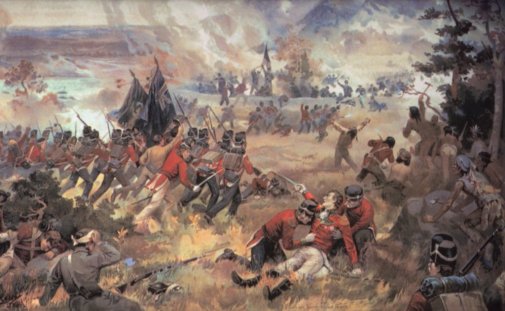
It has been almost 200 years since the fog of war, loomed thick on battlefields all across the North American continent from Sackets Harbour to Queenston Heights. Although the events of 1812, have receded into the mist of our collective memory the impact of those events still echoes through the centuries. Compared to other global conflicts during the 19th century, the war of 1812 is rather a minor affair. However, it had a significant impact in shaping the national character of the cobble together: colonies that became Canada.This week, the forgotten war, took front stage with a slew of federal announcements aiming to reintroduce Canadians to an important part of their past. The Canadian government invested over $28 million to commemorate the quickly approaching bicentennial of the war. As well this is another step for the Conservatives in rebranding the Canadian identity. It started with institutions like the monarchy and it continues now with historical events like the war of 1812. Simply put, the Harper government is adding to the idea of what it means to be Canadian. More importantly, providing a counterbalance to the traditional post modern liberal interpretation of Canadian history that our identity consists of the charter the flag and a gaggle of social programs.In addition, there is something remote and distant putting so much stock of our identity in symbols of postmodern Canada. Furthermore, it is healthy for a country to call upon cultural touchstones from our past it shows where we have come from as a country. Beyond the political context of our citizenry is a serious lack of understanding of our own historical events. When only four out of ten Canadians from the ages of 25 to 34 haven’t even heard of the war of 1812; that is a significant gap in our collective understanding of how Canada came to be. Not only did the events of 1812 inspire a sense of nationhood, the outcome of the war determined the border of North America for the last two centuries. In this writer’s opinion it is hard for the Canadian psyche to perceive our country, with having drastically different borders and culture.To the detractors that say that the government should not be spending any of the public’s money on historical events like the upcoming bicentennial. Conversely, what is wrong with a country reinvesting in points of its patriotic pride, especially when it is such a crucial historical event like the war of 1812. Now, a valid argument can be made for how much money should have been spent commemorating the war especially in a time of economic uncertainty. Finally, what’s wrong with a tad of chest pumping patriotism now and then? In retrospect, this “rebranding” and recognition of the role that the war of 1812 played in the Canadian sense of self is long overdue.
