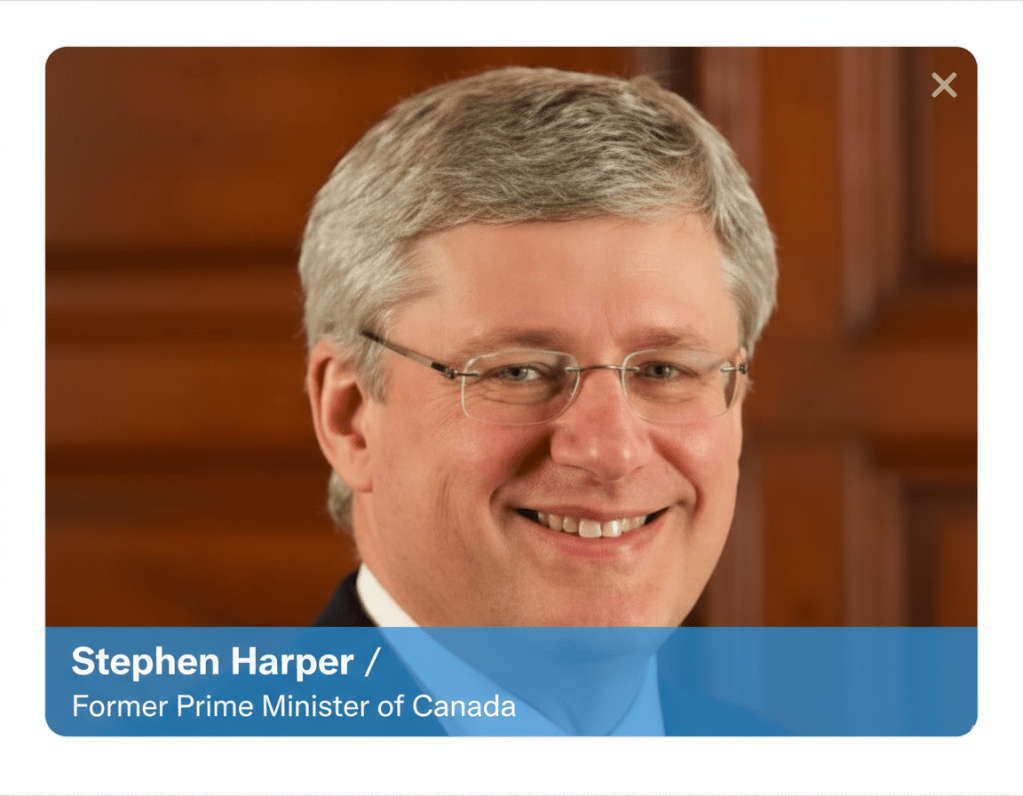
The legacy of Stephen Harper has dominated political discourse this week, and for good reason. As someone who came of age politically during Harper’s leadership, I’ve had time to reflect on what his tenure meant for Canada and what we’ve lost since.
I first got interested in politics, like many in my generation, by Stephen Harper’s run for prime minister in 2004. By 2006, after 13 years of Liberal rule that had grown stale and directionless, it became clear that Harper’s vision offered the change our country desperately needed.
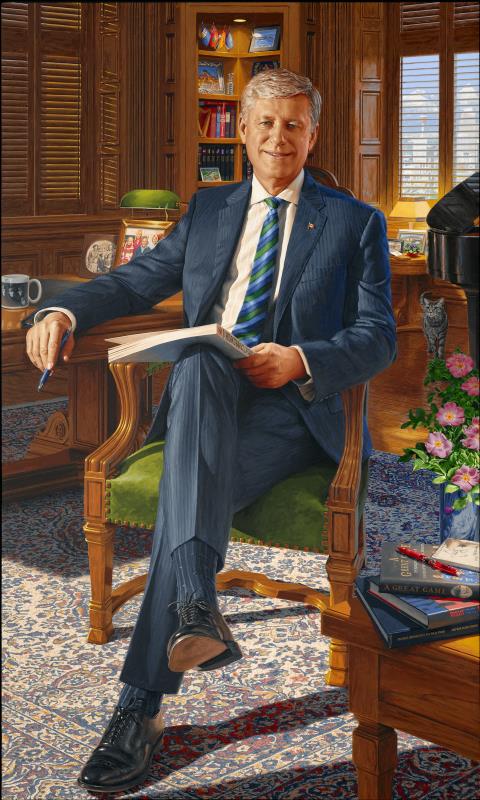
That election year, I volunteered for Terence Young’s campaign in my riding, who went on to become our Member of Parliament. At university, I threw myself into grassroots activism as a Young Conservative, knocking on doors, organizing events, and learning a fundamental truth that still holds today: common sense wins elections. This week’s commemoration, including the unveiling of Harper’s official portrait in Parliament and Pierre Poilievre’s tribute in the House of Commons, has sparked a necessary conversation about what effective leadership actually looks like.
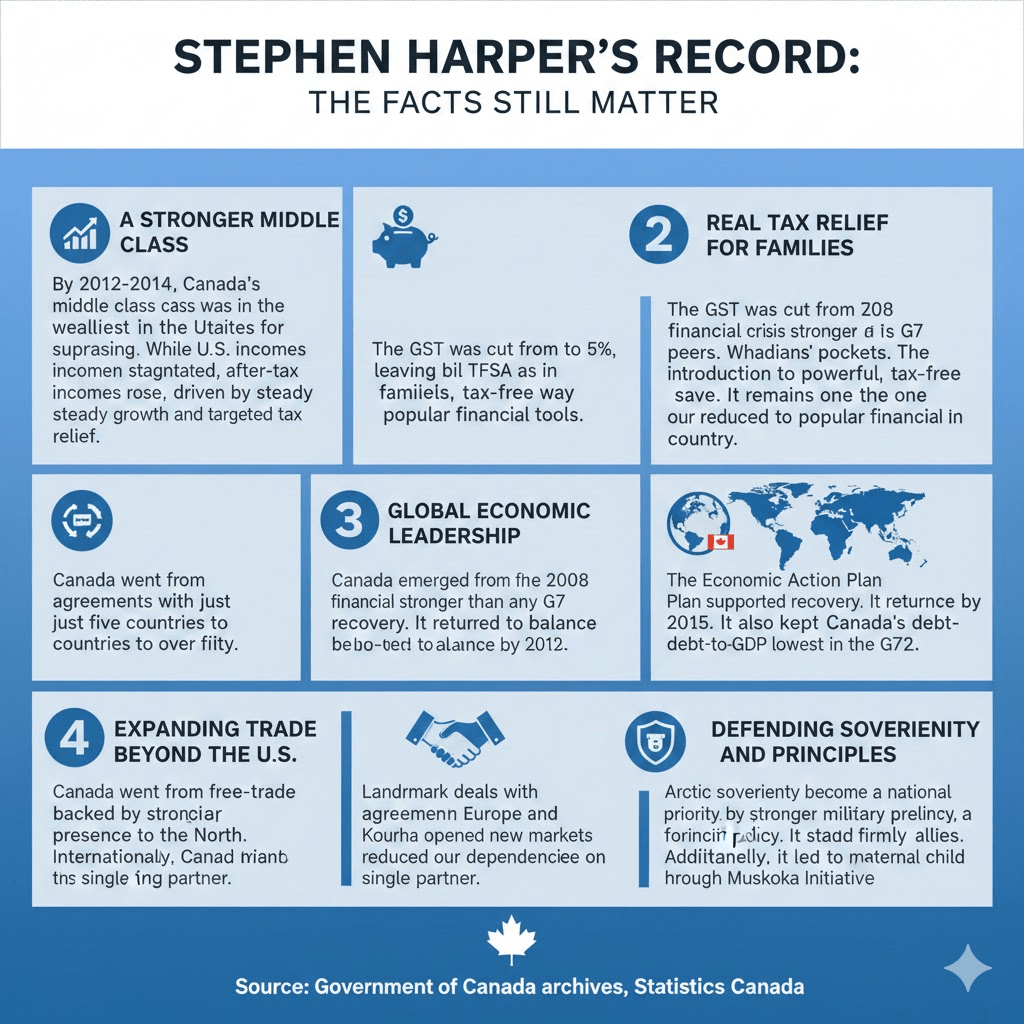
The contrast between then and now is stark. By the early 2010s, Canada’s middle class had reached unprecedented strength. While after-tax incomes stagnated in the United States, they were rising here at home. Families experienced tangible tax relief through measures like the GST cut and the creation of the Tax-Free Savings Account. These weren’t flashy announcements; they were substantive policy changes that gave Canadians more room to save, plan, and build better futures for themselves.
When the 2008 financial crisis struck, Canada emerged as the strongest economy in the G7. This wasn’t luck or a happy circumstance. It was the result of focused economic planning, disciplined fiscal management, and a commitment to returning to balanced budgets. Canada achieved the lowest debt-to-GDP ratio among G7 nations, positioning us as a model of economic stability during global uncertainty.
Beyond our borders, the Harper government expanded Canada’s trade relationships beyond our traditional dependence on the United States, opening new markets in Europe and South Korea. Canada asserted its Arctic sovereignty, stood firmly with democratic allies, and led internationally on maternal and child health through the Muskoka Initiative. These weren’t performative gestures — they were concrete actions that advanced Canadian interests and values on the world stage.
This week marked the 20th anniversary of that pivotal 2006 election, with Harper himself delivering Wednesday’s keynote address. Watching the commemorations, I couldn’t help but reflect on what we’ve witnessed in Canadian politics since. The current government has given us soaring rhetoric and progressive branding, but where are the results? Housing has become unaffordable for an entire generation. Inflation has eaten away at family budgets. Our debt has ballooned while productivity has stagnated.
The Harper years remind us that governing isn’t about crafting the perfect tweet or staging photogenic moments. It’s about making tough decisions, managing the public’s money responsibly, and delivering measurable improvements in people’s lives. It’s about building economic conditions where hard work actually leads to prosperity, not just more exhaustion.
Some critics have dismissed this week’s events as nostalgia or partisan cheerleading. I see it differently. This is about establishing a standard for what constitutes serious governance. It’s about reminding Canadians that we’ve experienced better — that a strong, stable, confident government focused on results rather than slogans is not only possible but something we’ve achieved in recent memory.
As we reflect on the Harper legacy, the question isn’t whether we agree with every policy decision made during those years. The question is whether we want a government that prioritizes results over rhetoric, substance over style, and the economic well-being of everyday Canadians over virtue signalling to international audiences.
This week has been more than a commemoration of one man’s service. It’s been a reminder of what Canadian governance can achieve when leadership is focused, disciplined, and committed to delivering for the middle class. As we face mounting economic challenges and an increasingly unstable world, perhaps the most significant lesson from the Harper years is simply this: serious times demand serious leadership.
The real test is whether we’ll demand that standard again.