Tag: politics

  • Adam Smith’s Wealth of Nations at 250

    This week marks 250 years since Adam Smith published The Wealth of Nations. This book fundamentally changed how we understand economics, markets, and the role of government.

    The anniversary has sparked discussion in the media, including here in Canada. Columnists are revisiting Smith’s ideas and debating how they continue to shape our economic policies.

    Even Pierre Poilievre contributed an opinion piece. He defended Smith’s legacy. He emphasized the importance of free markets for Canada’s future.

    Smith’s influence is hard to overstate. Before his work, economic thinking was dominated by rigid systems that assumed wealth was fixed. Governments tried to tightly control trade and production, convinced that one country’s gain always came at another’s expense.

    Smith challenged that view. He argued that prosperity grows when people are free to produce, trade, and innovate. These ideas still resonate in our debates about economic policy.

    One of his most famous insights was the power of specialization. Rather than one worker making an entire product from start to finish, each person focuses on a single step. That simple shift leads to a dramatic increase in productivity.

    Smith illustrated this with his famous example of a pin factory. When each worker handled a specific task, production soared compared to when one person tried to do everything alone. The lesson is clear: when people specialize and trade, everyone benefits.

    But Smith’s ideas went far beyond factories and markets. He helped define what we now call political economy. He shaped how we think about the relationship between government and the economy.

    At its core, political economy is about understanding the proper role of government in economic life. Smith believed the government had a crucial job. It should set fair rules, protect property rights, enforce contracts, and preserve the institutions that allow markets to work.

    But once those rules are in place, the government should step back. It should not try to micromanage the economy or decide which industries succeed or fail.

    When markets run under clear, fair rules, producers compete, prices show real supply and demand, and innovation thrives. In that system, people succeed by creating value for others.

    That insight still shapes many of the economic debates we have today.

    Two hundred and fifty years later, The Wealth of Nations remains one of the most influential books ever written. Its core message is simple but powerful. Prosperity grows when people are free to work, trade, and build. This happens within a system of fair rules.

    Put simply, the government’s job is to referee the game, not try to play it.
  • looked back at Stephen Harper, a decade of Canadian Prosperity

    looked back at Stephen Harper, a decade of Canadian Prosperity

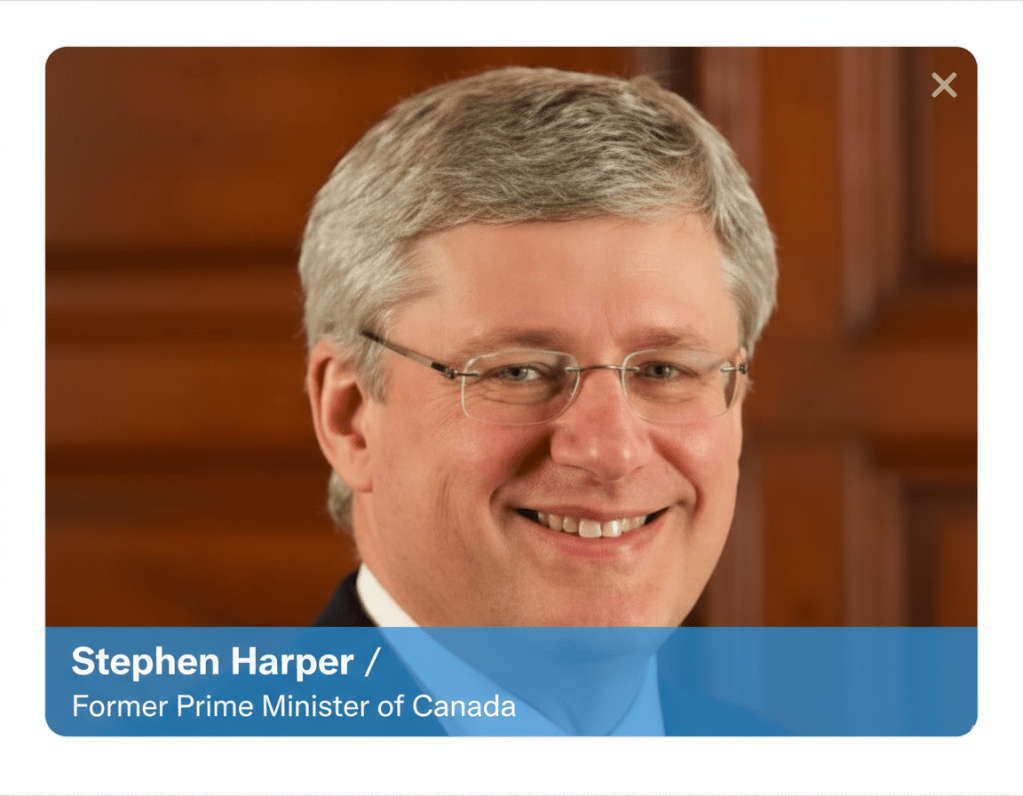
    Earlier this month, it was announced that former Prime Minister Stephen Harper will finally have his portrait unveiled in Parliament. For Canadian political leaders, this tradition often serves as the capstone of a public career. It is a formal and long-standing recognition of service to the country.

    The unveiling will naturally prompt renewed reflection on Harper’s full record in office. Commentators, political figures, and Canadians alike will revisit his years in power. They will weigh his decisions, priorities, and long-term impact on the country.

    The ceremony takes place in February. It coincides with the 20th anniversary of the Conservative Party’s first minority government. This coincidence adds historical weight to the moment. It marks an opportunity to step back from daily politics and assess a defining chapter in modern Canadian history.

    Under Harper, Canada experienced a decade marked by stability, economic resilience, and clear governing priorities. While opinions will vary, his time in office left a lasting imprint on the country.

    Here are a few of the key accomplishments that continue to shape his legacy.

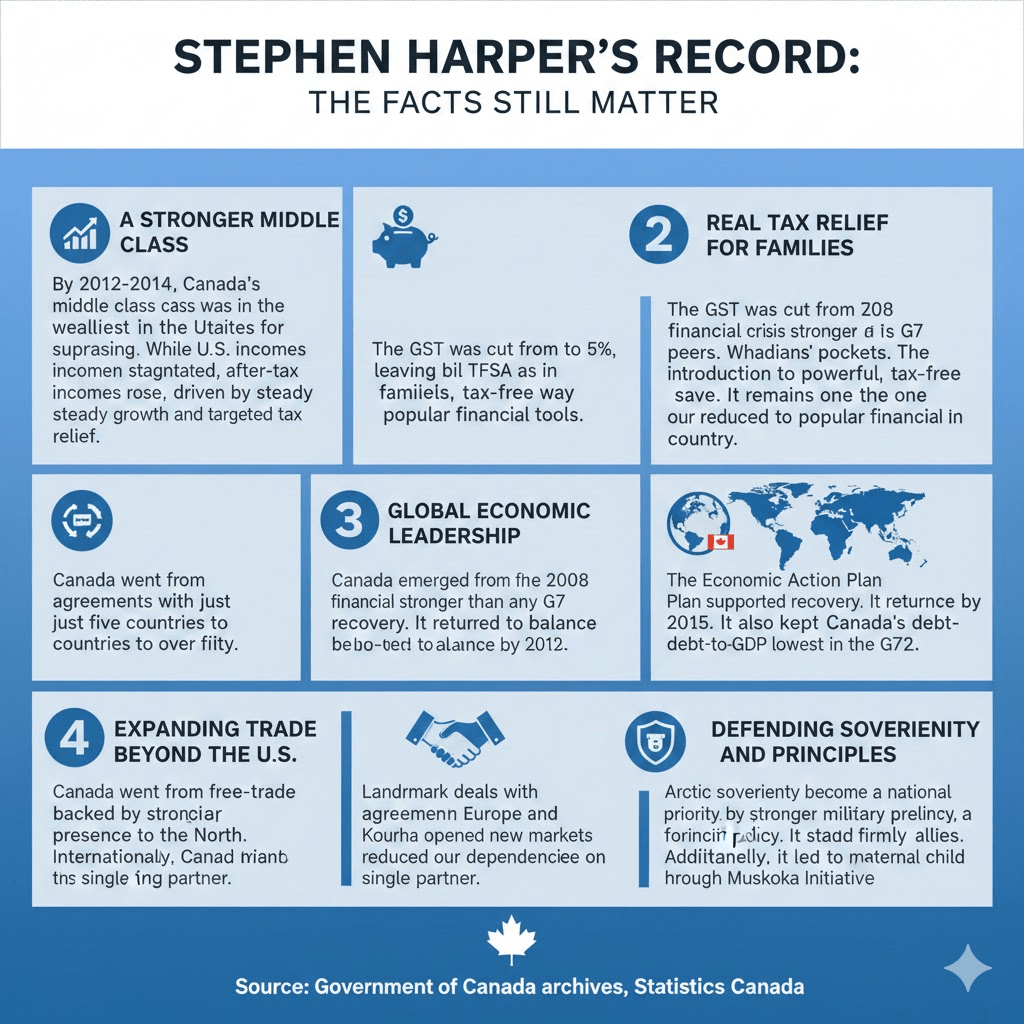
    Stephen Harper’s Record: The Facts Still Matter

    1. A Stronger Middle Class

    By 2012–2014, Canada’s middle class was the wealthiest in the world, surpassing the United States for the first time. While U.S. incomes stagnated, Canadian after-tax incomes rose, driven by steady growth and targeted tax relief.

    2 Real Tax Relief for Families

    The GST was cut from 7% to 5%, leaving billions in Canadians’ pockets. The introduction of the TFSA gave families a powerful, tax-free way to save. It remains one of the most popular financial tools in the country.

    3 Global Economic Leadership

    Canada emerged from the 2008 financial crisis stronger than any of its G7 peers. The Economic Action Plan supported recovery. It returned the budget to balance by 2015. It also kept Canada’s debt-to-GDP ratio the lowest in the G7.

    4 Expanding Trade Beyond the U.S.

    Canada went from free-trade agreements with just five countries to over fifty. Landmark deals with Europe and South Korea opened new markets and reduced our dependence on a single trading partner.

    5 Defending Sovereignty and Principles, Arctic sovereignty became a national priority, backed by a stronger military presence in the North. Internationally, Canada pursued a principled foreign policy. It stood firmly with democratic allies. Additionally, it led to maternal and child health through the Muskoka Initiative.

    In fact, former Prime Minister Stephen Harper has grown more popular since leaving office in 2015. A recent poll conducted by Research Co. ranked Harper second among Canada’s prime ministers since 1968.

    As we consider the Harper government, we see its clear record of accomplishment. This record stands as the true legacy of former Prime Minister Stephen Harper. It improved the lives of Canadians and served as a principled moral voice on the world stage.

    That legacy includes a full decade of strong, stable Conservative government for Canada.

  • The Political Risks of Crossing the Floor: A Betrayal of Voters

    Crossing the floor has always carried a heavy political price, and for good reason. When voters cast a ballot, they aren’t just choosing a name. They’re endorsing a set of values, a platform, and a team. That’s why Michael Ma’s decision to cross the floor feels like a betrayal. It feels like a slap in the face to the very people who helped put him in office.

    MP Michael Ma must return to his constituents. He needs to explain why he now supports the Liberal government’s inaction. Meanwhile, Canadians continue to struggle with rising food prices. They also face ongoing cost-of-living challenges.

    Voters in Markham–Unionville didn’t elect an independent free agent. They elected a representative aligned with a specific political banner and its accompanying commitments. Floor crossing breaks that basic trust. It tells voters that the promises made during an election campaign were conditional or, worse, disposable.

    Defenders of floor crossing often frame it as an act of conscience or principle. Sometimes, in rare circumstances, that may be true. But more often than not, it looks like political convenience dressed up as moral courage. Yes, Canada adopted the Westminster-style parliamentary system from Britain. This included the technical ability for individual MPs to cross the floor. But legality isn’t legitimacy. Just because the rules allow it doesn’t mean it’s right. This is especially true when it betrays the voters who entrusted their support to a clear platform and party banner. If an elected official truly believes they can no longer represent voters under the platform for which they were elected, they should resign. They should step down. They ought to seek a new mandate honestly. It is honest to seek a new mandate.

    That’s what accountability looks like. Anything less asks voters to accept a bait-and-switch that they never agreed to.

    When Members of Parliament continue to cross the floor like this, it only deepens cynicism about elections. Voters are left asking a fundamental question: What is the point of their vote? Politicians can change their minds so abruptly after being elected.

    Voter turnout is already trending downwards. Public confidence in institutions is under strain. Actions like this only make things worse. Democracy depends on clarity and consent. Floor crossing muddies both.

    Ultimately, this isn’t about partisanship. It’s about respect. Respect for voters. Respect for the electoral process. And respect for the idea that political power is borrowed

    The people of Markham–Unionville deserve much better.