Author: Jon Siemko

  • Priority Number One is Jobs, Jobs, Jobs


    On the weekend the Ontario PC Party released their five-point plan for job creation to get Ontario working again.


    • Treat energy policy as economic policy – not as a social program.


    • Train 200,000 more skilled workers by expanding the apprenticeship system.


    • Reduce taxes on job creators.


    • Eliminate job-killing red tape.


    • Lowering taxes on families so they have the confidence to spend  again.


    These priorities are in clear contrast with the Liberal plan to make Ontario a green jobs leader. One plan is a realistic way to re-energize job growth and the other is a expensive scheme to subsidized an entire sector that has not come to maturity yet. Now I don’t know about you, but I rather vote for a plan that has practical solutions for the problems confronting the province.
  • Green Jobs Turn Out to Be a Disaster

    From Ottawa Citizen

    The fact that power derived from the green energy act forms such a small proportion of Ontario’s power generation mix raises questions about the pace of the Liberal party’s signature subsidy plan, known as the Feed-in Tariff (FIT).
    Those questions were amplified late this week when the National Post revealed that a solar plant used for a Liberal campaign photo op days earlier had temporarily shut down production.
    When pressed on the issue, McGuinty subsequently explained that the company “went through their inventory faster than expected.”
    But even staunch proponents of renewable energy say there are obvious problems with the Liberal plan, which pays green energy producers above-market rates on 20-year contracts in return for buying up to 60 per cent of their project materials domestically.
    The heavy incentive (also known as micro-FIT for smaller installations by homeowners) was designed to kick-start an entirely new green energy manufacturing cluster in Ontario.
    However, bottlenecks in the system, doubt surrounding the future of the program and a challenge to the domestic-content provision at the World Trade Organization, have reduced to a trickle the number of projects becoming a reality in the province.
    No less an authority than Ontario’s environmental commissioner, Gord Miller, remarked on the slow progress of the program this summer, telling a press conference, “There’s been an awful lot of discussion about something that’s fairly modest so far, I’d say.”

    Simply put the Liberals don’t seem to have any problem treating economic policy as a laboratory experiment. Meanwhile, the taxpayers have to pick up the tab for technology that has not yet come to maturity. No government can subsidize their way to prosperity.

  • Imagine Turbines Over Tuscany

    From Owen Sound Sun Times

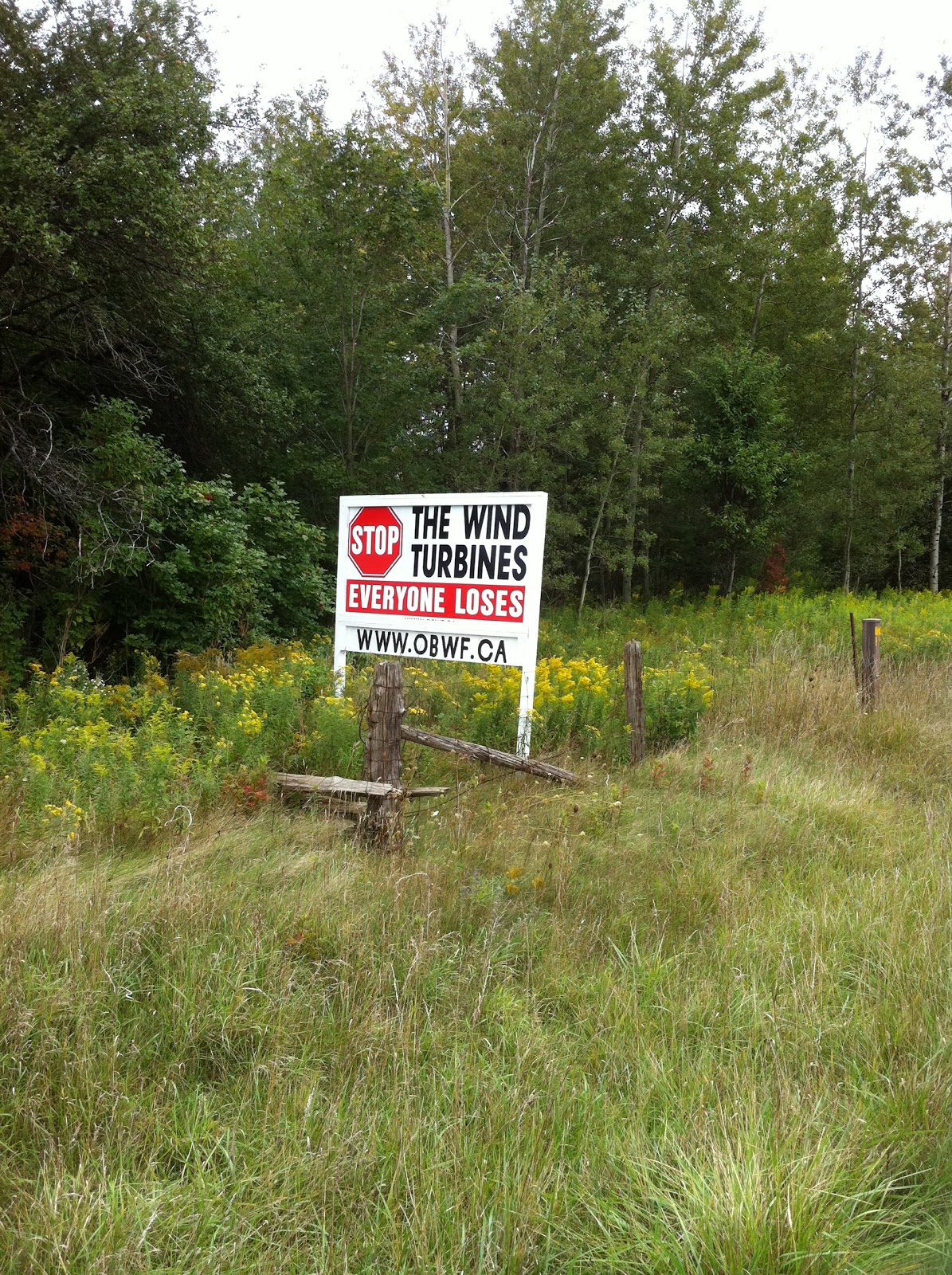
    If you haven’t seen them take a drive south to Lake Erie along historic Highway 3 between Blenheim and Leamington. On a windy day, “The sound is like a freight train,” says Dave Benson, Heritage Coordinator for the Municipality of Chatham and Kent. “A modest house is worth 30 per cent less and a million-dollar property is unsaleable.” Are they ugly? You bet. Texan billionaire T. Boone Pickins, a heavy investor in wind power, has said he won’t put any turbines on his 68,000 acres. On a gorgeous fall day the rolling hills of golden fields east of Lake Huron rival Tuscany. Imagine turbines over Tuscany.
    Yet, McGuinty talks proudly in television election ads of 900 turbines installed so far. However, with the exception of one Lake Ontario project, the power’s not going anywhere. Wind farms along Lakes Huron and Erie are not, as yet, on the grid. While this is talked about locally, few Ontarians are aware that the turbines are mainly just gigantic lawn ornaments.

    There is obviously a groundswell of grassroots support against the green energy act in wind farms. However,  the Ontario Liberals proceed with a program that is perceived by some to be antidemocratic. Further fostering a sense that the government of Ontario, Only cares about issues in Toronto. Talk about the politics of division.